
Getting pulled over can be stressful, even when you believe you have done nothing wrong. You may be driving home with friends or family when red and blue lights suddenly appear behind you.
Your heart may start beating faster. You may feel nervous and begin talking more than you normally would. The officer may sound friendly, serious, or irritated, and you may not know how to respond.
Knowing what to say, what not to say, and how to control your movements can keep a simple traffic stop from becoming a bigger problem.
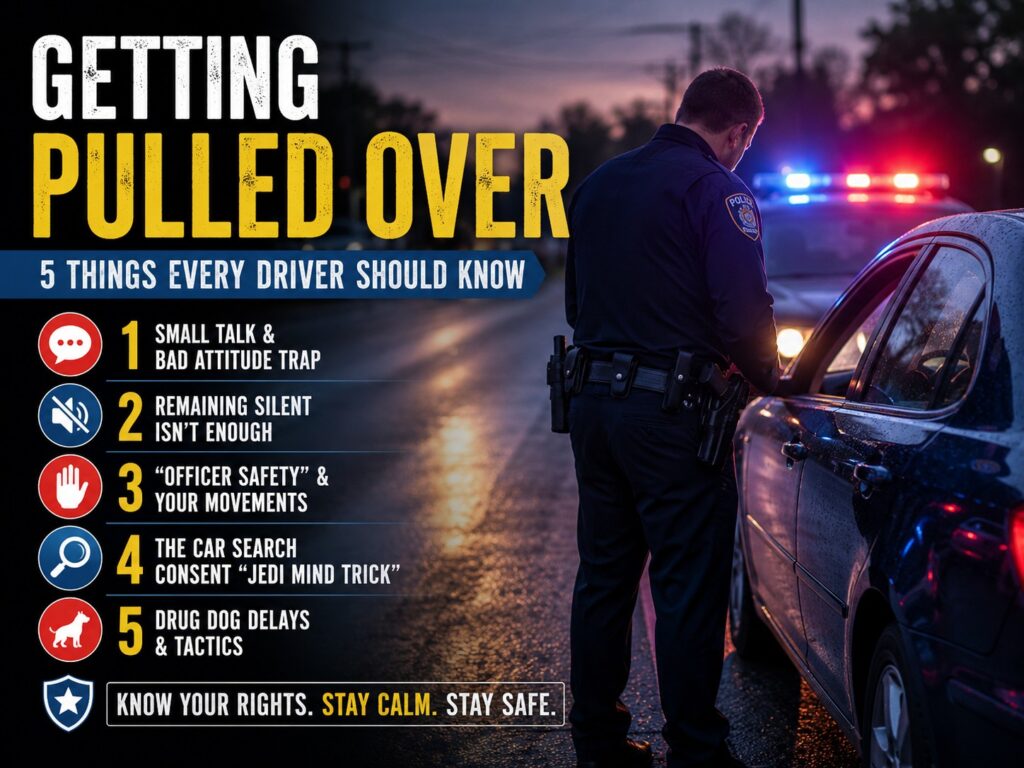
This article covers five situations drivers should understand when getting pulled over. Laws can vary by state, so this is general safety and educational information, not personal legal advice.
Disclaimer: I am not a lawyer, and this article is not legal advice. The information here is based on things I have learned over the years from speaking with police officers, attorneys, and other people, along with my own research and experience. Laws can vary by state and situation, so speak with a qualified attorney if you need legal advice about a traffic stop or police encounter. In my opinion, it is always best to remain calm and respectful during interactions with law enforcement officers.
1. Getting Pulled Over and Casual Small Talk
When the officer reaches your window, the conversation may begin with questions that sound harmless:
- Where are you coming from?
- Where are you going?
- What were you doing tonight?
- Did you have anything to drink?
- Do you know why I stopped you?
Not every officer asking these questions is trying to trick you. An officer may be trying to understand the situation, watch how you respond, or gather information connected to the stop.
However, your answers can also create more questions.
Saying you just left a bar may lead to questions about drinking. Guessing how fast you were driving may sound like you are admitting that you were speeding. Talking too much may give the officer information you never needed to provide.
You do not have to become rude or disrespectful. You can remain calm and polite while limiting the conversation.
You could say:
“Officer, I would rather not answer questions.”
You will generally still need to provide the documents required for driving, including your driver’s license, registration, and proof of insurance. The exact requirements depend on the state where the stop happens.
2. What to Say When Getting Pulled Over
Many people believe that remaining completely silent automatically protects them. The situation can be more complicated than that.
It is clearer to state that you are exercising your right to remain silent instead of simply refusing to speak.
You could say:
“I am exercising my right to remain silent, and I do not want to answer questions.”
Remaining silent does not mean ignoring every lawful instruction. It also does not normally remove your responsibility to provide the documents and identifying information required for operating a vehicle in your state.
Do not give a false name, fake date of birth, or dishonest explanation. It is better to politely decline to answer than to make something up.
Keep your response short:
“Here is my license and registration. I am exercising my right to remain silent.”
3. Keep Your Hands Visible When Getting Pulled Over
A driver may know that they are only reaching for a wallet, registration, or cellphone. The officer approaching the vehicle does not automatically know that.
Keep both hands where the officer can see them. The steering wheel is usually the easiest place.
Avoid quickly reaching under your seat, inside your pockets, or toward the glove box. When you need to get something, explain what you are doing before you move.
For example:
“My registration is in the glove box. Is it okay if I reach for it?”
Wait for an answer and then move slowly.
Other helpful steps include:
- Pulling over in a safe location
- Placing the vehicle in park
- Lowering the window
- Turning on the inside light at night
- Keeping passengers calm
- Avoiding sudden movements
- Telling the officer where your documents are located
During a lawful traffic stop, an officer may generally order the driver to step out of the vehicle.
Even when you think the order is unnecessary or unfair, do not lock the door, pull away, or physically resist. Follow the instruction calmly and deal with any legal disagreement afterward.
Your strongest position is to be the calm person shown on the officer’s body-camera footage.
Recording While Getting Pulled Over
A recording can help preserve what both you and the officer said. However, quickly reaching for a cellphone may create confusion.
When possible, start the recording without holding the phone in your hand. A mounted phone or voice command may allow you to record while keeping your hands visible. A passenger may also be able to record, but that person should avoid sudden movements or interfering with the stop.
Tell the officer what you are doing:
“Officer, I want you to know that I am recording this interaction.”
Do not push the phone toward the officer, climb out to get a better angle, or ignore instructions about your hands.
Recording and audio-consent laws can differ by state. Recording should never interfere with the officer performing the traffic stop.
4. Getting Pulled Over and a Request to Search Your Car
An officer may ask whether you have anything illegal inside your vehicle.
After you say no, the officer may ask:
“Then you wouldn’t mind if I searched your car, would you?”
That question can be confusing. A yes-or-no answer may not clearly explain whether you are agreeing to the search.
Use a complete sentence that cannot easily be misunderstood:
“I do not consent to a search of myself or my vehicle.”
You do not need to become angry or give a long speech. Repeat the same clear sentence when necessary.
Refusing consent does not guarantee that a search will not happen. An officer may still search under a warrant, probable cause, or another recognized exception to the warrant requirement.
If the officer searches anyway, do not grab the officer, stand in the way, or physically fight over the vehicle.
Say:
“I do not consent to this search.”
Then remain calm. The legality of the search can be challenged later. The roadside is not the safe place to physically fight over a legal question.
Why Agreeing to a Search Can Create Problems
Once you give permission, the search may be more extensive than you expected.
The officer may look through bags, containers, the trunk, and other areas that could fall within the permission you gave. The stop may also last much longer.
You may not know everything that is inside your vehicle. A friend, relative, or other passenger may have left something behind without telling you.
Refusing consent does not mean you are admitting that something illegal is inside the vehicle. It means you are choosing not to voluntarily give up a constitutional protection.
Stay polite and use clear wording:
“I understand, officer, but I do not consent to a search.”
5. Drug Dog Delays When Getting Pulled Over
An officer may tell you that a drug-detection dog is being called to the scene.
A dog may arrive while the officer is still completing the normal work related to the traffic stop. However, police generally cannot add time to an otherwise completed traffic stop only to wait for a dog unless there is separate legal justification.
You can calmly ask:
“Officer, am I free to leave?”
If the officer says yes, leave safely. Do not stay beside the road to argue.
If the officer says no, do not drive away. Say:
“I am exercising my right to remain silent. I do not consent to any searches.”
If you are recording, quietly note the time. Continue keeping your hands visible and avoid turning the delay into a roadside argument.
What If the Officer Has a Bad Attitude?
Some officers may sound irritated, impatient, or disrespectful. You may believe the officer is trying to get an emotional reaction from you.
Do not take the bait.
Getting loud, insulting the officer, or making threatening statements can shift attention away from the reason for the stop and place your own behavior under closer examination.
Use short responses:
- “Yes, officer.”
- “No, officer.”
- “I do not understand the instruction.”
- “I am exercising my right to remain silent.”
- “I do not consent to a search.”
- “Am I free to leave?”
Remaining calm does not mean you agree with the officer. It means you are protecting yourself from an unnecessary escalation.
Respect should go both ways. Drivers should avoid threatening behavior, and officers should communicate clearly and treat people professionally.
Do Not Fight Your Case Beside the Road
You may do everything right and still receive a ticket, be searched, or get arrested.
Do not run. Do not fight. Do not try to physically stop officers from placing you in handcuffs or searching the vehicle.
If arrested, say:
“I am exercising my right to remain silent. I want to speak with an attorney.”
Do not attempt to explain the entire situation from the back of a police vehicle.
Save anything connected to the stop, including:
- Video or audio recordings
- Tickets and other paperwork
- The location and approximate time
- Officer names or badge numbers
- Witness names
- Photographs of the vehicle
- A written account of what happened
Write down the details while they are still fresh. An attorney can determine whether the stop, detention, or search should be challenged.
Getting Pulled Over Does Not Have to Become a Fight
Knowing your rights does not mean challenging every sentence, ignoring instructions, or treating every police officer like an enemy.
It means knowing when to remain silent, how to clearly refuse consent, when to ask whether you are free to leave, and how to protect yourself without making the encounter more dangerous.
Remember the most important steps:
- Pull over safely.
- Keep your hands visible.
- Explain your movements.
- Provide the documents required by law.
- Do not lie.
- Clearly state when you are remaining silent.
- Say, “I do not consent to a search.”
- Ask, “Am I free to leave?”
- Never physically resist beside the road.
A traffic stop is not the place to win an argument. Stay calm, document what happened, and handle legal disagreements through the proper process afterward.
For more everyday safety information, visit the Best Defense Tools homepage.
When getting pulled over, your calm response may be the most important safety tool you have.